Israel’s recent war with Iran served as a cautionary tale for countries with sophisticated missile defenses and those that seek to have them. Over 12 days, Iran pierced Israel’s defenses with increasing success, showing that even the world’s most advanced systems can be penetrated.
While most of Iran’s missiles and drones were knocked down, Tehran changed tactics and found gaps in Israel’s armor through trial and error.
Tehran began to launch more advanced and longer-range missiles from a wider range of locations deep inside Iran, according to missile-defense experts who analyzed open-source data and public images of missile fragments. The regime also altered the timing and pattern of attacks and increased the geographic spread of targets, the analysts found.
As the war went on, Iran fired fewer missiles, but its success rate rose, according to a Wall Street Journal analysis of data from think tanks based in Israel and Washington, D.C.
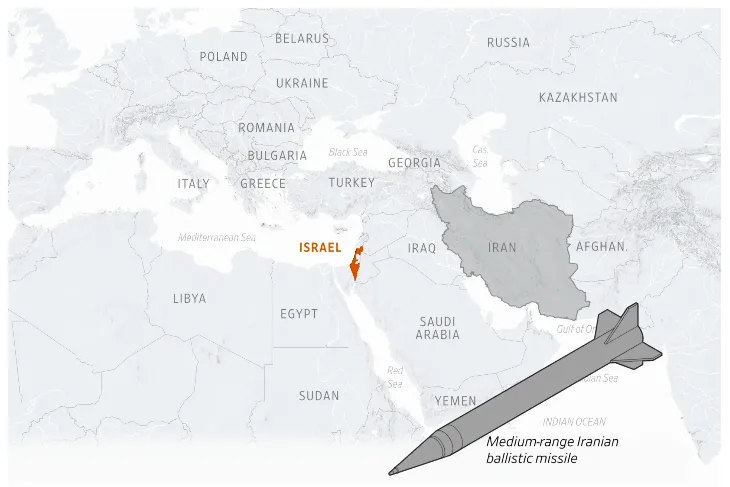
The Offense Most missiles launched against Israel are medium-range ballistic missiles that can cover a range of up to 1,200 miles.
<figure><img src="/img//img/2026/09/efd04195265945d57d.webp" alt="Through Trial and Error, Iran Found Gaps in Israel’s Storied Air Defensed — 2" loading="lazy" decoding="async" /></figure> First Layer of Defense Israeli Arrow 3 missiles are used initially. They consist of a two-stage interceptor that destroys targets up to 1,550 miles away at altitudes outside the atmosphere. They take out incoming threats through direct impact
<figure><img src="/img//img/2026/09/40fef7e64b94ee0ca1.webp" alt="Through Trial and Error, Iran Found Gaps in Israel’s Storied Air Defensed — 3" loading="lazy" decoding="async" /></figure> First Layer of Defense Additionally, U.S. Navy SM-3 (also named Aegis) interceptors with a sophisticated radar and fire-control system are deployed from the Mediterranean and can engage missiles both inside and far outside the atmosphere. They can destroy targets up to 745 miles away
<figure><img src="/img//img/2026/09/f6b02e9e78111dc52b.webp" alt="Through Trial and Error, Iran Found Gaps in Israel’s Storied Air Defensed — 4" loading="lazy" decoding="async" /></figure> Second Layer of Defense Missiles that evade interception outside of the atmosphere are then engaged inside the atmosphere by Arrow 2, which intercepts long-range ballistic missiles. Arrow 2 uses a proximity-fuzed warhead to destroy its target by detonating when it gets close enough to it
<figure><img src="/img//img/2026/09/45d60f154e1f87bc6c.webp" alt="Through Trial and Error, Iran Found Gaps in Israel’s Storied Air Defensed — 5" loading="lazy" decoding="async" /></figure> Second Layer of Defense The Terminal High Altitude Area Defense (Thaad) is an American anti-ballistic missile system. It can be used as backup against missiles both outside and inside the atmosphere, as long as they are within a range of around 185 miles
<figure><img src="/img//img/2026/09/81facb570e183c4845.webp" alt="Through Trial and Error, Iran Found Gaps in Israel’s Storied Air Defensed — 6" loading="lazy" decoding="async" /></figure> Third Layer of Defense David’s Sling defends against medium-range missiles and heavy rockets within 185 miles, as well as cruise missiles. It uses a hit-to-kill mechanism within the atmosphere
<figure><img src="/img//img/2026/09/3f8f446f262015b945.webp" alt="Through Trial and Error, Iran Found Gaps in Israel’s Storied Air Defensed — 7" loading="lazy" decoding="async" /></figure> Fourth Layer of Defense Iron Dome protects against short-range rockets, missiles and mortars within a range of 75 miles. It uses a proximity-fuzed warhead and prioritizes threats headed toward populated areas or strategic sites. Iron Dome is also capable of intercepting missile fragments and drones [Note: Missiles are to scale to each other but not to other equipment. Sources: Mora Deitch, head of the Data Analytics Center at the Institute for National Security Studies (INSS) at Tel Aviv University, Israel, and Dr. Yehoshua Kalisky, senior researcher at INSS](Note: Missiles are to scale to each other but not to other equipment.Sources: Mora Deitch, head of the Data Analytics Center at the Institute for National Security Studies (INSS) at Tel Aviv University, Israel, and Dr. Yehoshua Kalisky, senior researcher at INSS)
In the first half of the conflict, 8% of Iran’s missiles slipped through Israel’s defenses. By the second half of the war, 16% got past Israel’s interceptors, according to data from the Washington-based Jewish Institute for National Security of America, or Jinsa.
The success rate doesn’t take into account missiles that failed to launch or were intercepted before reaching Israeli airspace, said Mora Deitch, head of the Data Analytics Center at the Institute for National Security Studies at Tel Aviv University. Nor does it distinguish between missiles that were allowed to strike open areas in Israel and those that Israeli interceptors missed, said Deitch, whose think tank provided data on Iranian strikes and Israeli defense capabilities.
Iran’s most successful set of attacks came on June 22, two days before the end of the war, when 10 out of 27 missiles hit Israel, according to the Jinsa data. The data suggest that Iran successfully adapted “how, when and what” it was firing, said Ari Cicurel, associate director of foreign policy at Jinsa.
The Israeli military declined to comment on Jinsa’s figures beyond saying it doesn’t share specifics on interception rates.
Israel’s aerial defense—including the famed Iron Dome that intercepts short-range rockets from Gaza and Lebanon—is among the best in the world and was developed in partnership with the U.S.
“Any missile system, even a sophisticated one like Israel’s, will leak eventually,” said Raphael Cohen, a senior political scientist at Rand, created as a Pentagon think tank. “The key for any air-defense system is less that you build a perfect system with any one layer and more the cumulative effect.”
An analysis of Israel’s public statements indicates that its interception rate declined over the course of the war. During the conflict, the Israeli military said it was intercepting 90% to 95% of Iran’s missiles. After the cease-fire on June 24, the military said it had intercepted 86% overall.
In January, President Trump signed an executive order to develop the “Iron Dome for America,” a $175 billion missile-defense system originally named after Israel’s array and now called Golden Dome, to protect the U.S. from potential missile attacks. America’s size would make its skies much harder to defend than Israel’s.
Location of damage points:
<figure><img src="/img//img/2026/09/cfcdd04a2f3017066c.webp" alt="Through Trial and Error, Iran Found Gaps in Israel’s Storied Air Defensed — 8" loading="lazy" decoding="async" /></figure> Note: Map includes locations of reported likely damage up to June 23 and is not exhaustive. Source: Damage analysis of Copernicus Sentinel-1 satellite data by Corey Scher and Jamon Van Den Hoek of Oregon State University’s Conflict Ecology lab (damage points) Drew An-Pham/WSJ
Ukraine offers a better example of defending a large territory over a yearslong war, but its air defenses are a patchwork of American, European and homegrown technologies. Israel’s advanced integrated system is more akin to what the U.S. seeks to develop, Cohen of Rand said.
Israel’s own success at attacking Iranian missile launchers prevented Iran from deploying its older, less accurate and shorter-range missiles. But it also meant that Tehran reached for its more advanced and longer-range missiles sooner in the conflict.
Fragments of Iran’s hypersonic Fattah-1 missile fell in at least two Israeli towns, according to footage of debris analyzed by missile experts.
The Fattah-1 descends at a sharp angle from outside the Earth’s atmosphere at over 10 times the speed of sound and features a warhead that detaches in flight and can dodge interceptors. Only Israel’s most advanced systems—the Arrow 3 and David’s Sling—can change course midflight to track it.
Iranian missiles that reached Israeli airspace, June 13–24:
<figure><img src="/img//img/2026/09/7977b79dc688730499.webp" alt="Through Trial and Error, Iran Found Gaps in Israel’s Storied Air Defensed — 9" loading="lazy" decoding="async" /></figure> <figure><img src="/img//img/2026/09/bc434585541f215551.webp" alt="Through Trial and Error, Iran Found Gaps in Israel’s Storied Air Defensed — 10" loading="lazy" decoding="async" /></figure>
Iran also pivoted from firing large overnight barrages to launching smaller waves during daylight hours and from a wider variety of locations.
Tehran further tested Israel’s interceptors by changing up its firing patterns, targeting far-apart cities and varying the intervals between attacks.
“They tried to separate the Israeli defense system,” said Yehoshua Kalisky, a missile-defense expert at INSS.
As the conflict wore on, a declining number of interceptors and their high cost would also have compelled Israel to conserve resources and only target missiles from Iran that posed the greatest threat, missile experts said.
Israeli and Iranian officials have independently called for reviews of their aerial capabilities.
“We are both on a learning curve,” said Kalisky, “they’re trying to improve their attacks, and we, our defense.”
By Zvi Smith and_Benoit Faucon_ Through Trial and Error, Iran Found Gaps in Israel’s Storied Air Defenses
- *Fa Version**